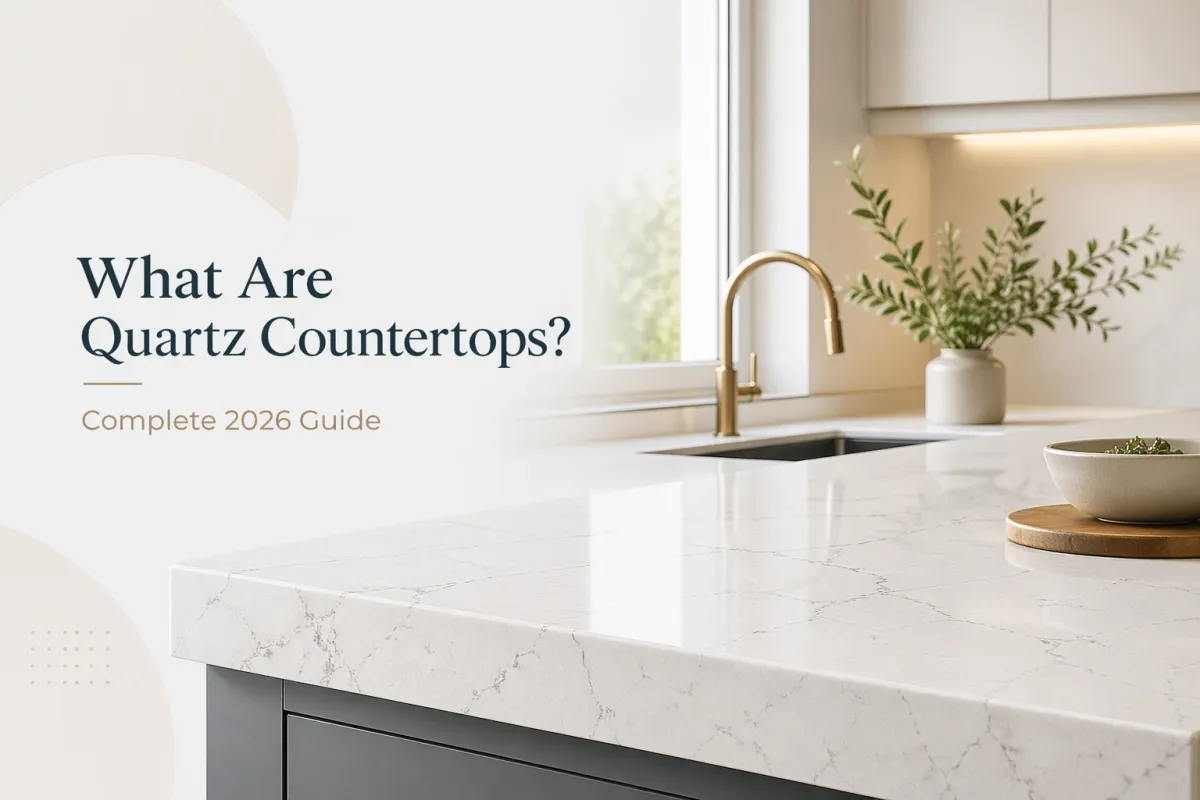
What Are Quartz Countertops and Are They Worth It?
Quartz Countertops Guide 2026: What Many homeowners face surface problems like stains, cracks, and high maintenance. Quartz countertops solve these issues by offering durability, consistency, and low upkeep. You need a surface that resists damage and supports daily use without constant care.
We provide structured guidance based on material science, manufacturing data, and real-world usage patterns. This guide explains quartz countertops with clear facts, comparisons, and maintenance insights. You will understand performance, costs, and limitations before making a decision. Next, explore what quartz countertops actually are.
What are quartz countertops?
Quartz countertops are engineered stone surfaces made from crushed quartz crystals and polymer resins. Manufacturers combine ~90–95% quartz with binders to produce durable, non-porous slabs used in kitchens and bathrooms.
Quartz surfaces deliver consistency and hygiene. Engineered production removes natural defects found in stone. These surfaces resist moisture and bacterial growth, which improves long-term usability.
What defines engineered quartz countertops?
Engineered quartz combines natural minerals with synthetic binders.
Quartz crystals provide hardness.
Resins create flexibility and binding.
Pigments ensure uniform appearance.
What are quartz countertops made of?
Quartz countertops consist of mineral particles and synthetic binders that create a dense and resilient surface. Each component directly affects durability, color stability, and resistance properties.
Material composition determines performance. Higher quartz percentages increase hardness, while resin quality affects flexibility and stain resistance.
What materials form quartz countertops?
Core materials define the structure and behavior of quartz slabs.
Crushed quartz (90–95%) → provides strength.
Polymer resins (5–10%) → bind materials.
Pigments → control color consistency.
Additives → enhance UV or scratch resistance.
How are quartz countertops manufactured?
Manufacturers use engineered stone processes to produce quartz slabs with high density and uniformity. Controlled environments ensure consistent quality across batches.
Production methods influence durability and finish quality. Advanced systems reduce air pockets and improve structural integrity.
What is the quartz slab manufacturing process?
The manufacturing process follows precise industrial steps.
Mix quartz, resin, pigments.
Compress using vacuum vibrocompression.
Cure at controlled temperatures (~90°C).
Calibrate thickness and dimensions.
Polish for surface finish.
Breton technology dominates global production.
Vacuum pressure removes air gaps.
What are the benefits of quartz countertops?
Quartz countertops provide durability, hygiene, and low maintenance. Non-porous structure prevents liquid absorption and reduces bacterial growth.
These benefits make quartz a preferred option for kitchens and bathrooms. Consistent patterns improve design control compared to natural stone.
Why choose quartz countertops?
Quartz surfaces deliver measurable advantages.
Resist stains due to non-porous surface.
Require no sealing.
Maintain consistent patterns.
Offer high scratch resistance.
Support easy cleaning routines.
Quartz vs granite countertops: which is better?
Quartz is better for maintenance and consistency, while granite countertops is better for heat resistance. Both materials provide high durability but differ in structure and care requirements.
Material selection depends on usage patterns. Kitchens with heavy heat exposure may benefit from granite, while low-maintenance needs favor quartz.
How does quartz compare to granite?
Each material performs differently across key attributes.
Quartz → non-porous and consistent.
Granite → natural and heat-resistant.
What are the problems with quartz countertops?
Quartz countertops have limitations related to heat resistance, UV exposure, and impact damage. These factors affect performance in specific environments.
Understanding disadvantages prevents misuse. Proper installation and usage reduce most risks.
What are common quartz countertop disadvantages?
Key limitations impact long-term performance.
Heat above ~150°C damages resin.
UV exposure causes discoloration.
Heavy impact may chip edges.
What are common quartz myths?
Misconceptions create unrealistic expectations.
“Quartz is indestructible” → false.
“Quartz is fully natural” → false.
Where should you use quartz countertops?
Quartz countertops perform best in indoor environments with controlled temperature and lighting. These conditions protect resin integrity and color stability.
Application choice affects lifespan and performance. Indoor installations maximize durability and appearance retention.
What are the best places for quartz countertops?
Quartz surfaces fit specific residential areas.
Kitchens → hygiene and durability.
Bathrooms → moisture resistance.
Backsplashes → visual consistency.
How much do quartz countertops cost in 2026?
Quartz countertops cost between $50 and $150 per square foot installed in 2026. Price varies based on brand, thickness, and customization level.
Cost reflects material quality and installation complexity. Premium brands and finishes increase overall investment.
What factors affect quartz countertop pricing?
Several variables influence total cost.
Brand (Caesarstone, Silestone).
Thickness (2cm vs 3cm).
Edge profiles and finishes.
Installation complexity.
How do you maintain quartz countertops?
Quartz countertops require minimal maintenance due to their non-porous structure. Regular cleaning preserves appearance and prevents buildup.
Simple routines extend surface lifespan. Avoiding harsh conditions prevents damage.
What are quartz countertop maintenance tips?
Effective care ensures long-term durability.
Clean with mild soap and water.
Use pH-neutral cleaners for stains.
Avoid abrasive scrubbers.
Use trivets for hot items.
Use cutting boards to prevent scratches.
FAQ: Quartz Countertops Explained
Are quartz countertops heat resistant?
Quartz resists moderate heat but resins degrade above ~150°C. Always use heat protection.
Can quartz countertops crack?
Quartz can crack under extreme impact or poor installation. Proper support reduces risk.
Do quartz countertops need sealing?
Quartz does not require sealing due to its non-porous resin structure.
How durable are quartz countertops?
Quartz ranks ~7 on Mohs hardness scale and lasts 20–30 years with proper care.
Do quartz countertops stain or scratch?
Quartz resists stains strongly and scratches moderately under sharp objects.
Are quartz countertops worth it in 2026?
Quartz offers durability, low maintenance, and consistent design, making it a practical long-term investment.
